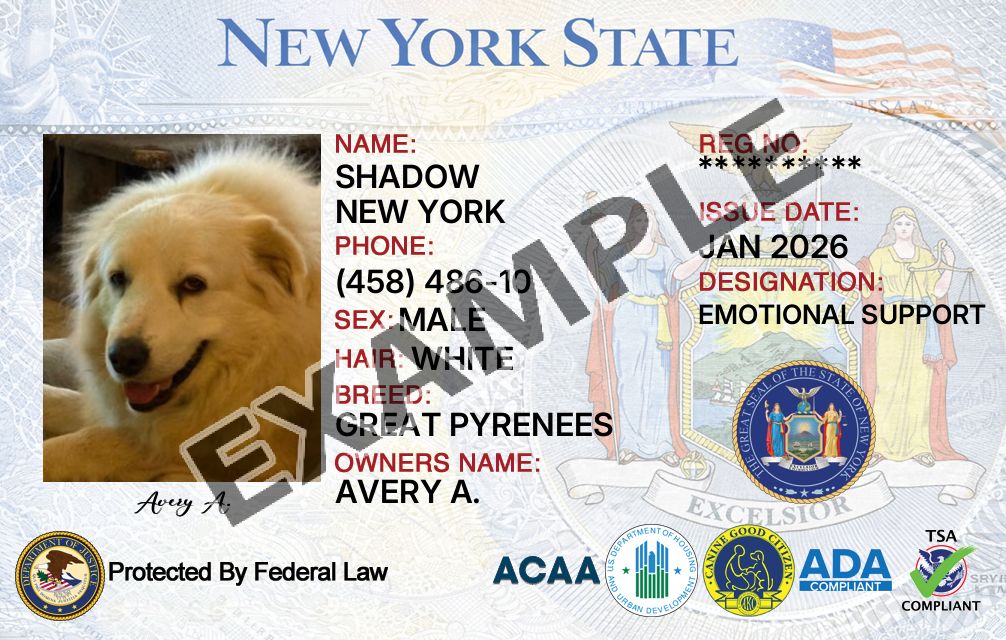
If you’re searching where do i register my dog in Niagara County, New York for my service dog or emotional support dog, the most important thing to know is this: there is no special “service dog registry” or “emotional support dog registry” required by law—but your dog may still need a regular dog license in Niagara County, New York, which is typically issued by your local city, town, or village clerk.
This page explains where to register a dog in Niagara County, New York, how local licensing usually works, what rabies paperwork is commonly required, and how licensing differs from service dog legal status and emotional support animal (ESA) documentation.
- Dog licensing is an official government function handled locally (city/town/village clerk offices).
- Service dogs do not need a “registration” to be recognized under federal law.
- Emotional support animals (ESAs) are not service dogs and generally don’t have public-access rights.
- A current rabies vaccination certificate is commonly required to obtain or renew a license.
Where to Register or License Your Dog in Niagara County, New York
In Niagara County, dog licensing is often handled by the municipality where you live (your city, town, or village). Below are several example official offices within Niagara County that commonly handle dog licenses, renewals, and related questions. If you don’t see your municipality listed, contact your local Town/City/Village Clerk for the correct licensing authority.
Town of Niagara — Town Clerk & Tax Collector
Town of Newfane — Clerk’s Office
City of Lockport — City Clerk / City Offices
City of North Tonawanda — Clerk/Treasurer (City Clerk)
Village of Youngstown — Clerk’s Office (Village Hall)
Niagara County Department of Health — Rabies Information (Clinics/Questions)
Overview of Dog Licensing in Niagara County, New York
What “registering your dog” usually means
In everyday conversation, “registering” your dog typically means obtaining a municipal dog license. A dog license is a government-issued record tied to your dog and your residence. It often comes with a numbered tag. Licensing helps local animal control and dog control officers identify dogs, contact owners, and confirm rabies vaccination status when needed.
Who issues the license in Niagara County?
A key point for anyone asking where to register a dog in Niagara County, New York: most licensing is handled locally—meaning the city/town/village clerk (or a designated local licensing authority) where you live. Niagara County and the Niagara County Department of Health may be involved in public health functions such as rabies education and clinics, but the license itself is commonly issued by your municipality.
Why rabies matters for licensing
Rabies is a public health concern. Many local governments require proof of current rabies vaccination (or, in limited cases, a veterinary exemption) to issue or renew a dog license. Keeping your rabies certificate current also reduces delays if your dog is involved in a bite incident or exposure investigation.
How Dog Licensing Works Locally in Niagara County, New York
Step-by-step: the typical process
- Confirm your licensing jurisdiction. Your dog is usually licensed through the municipality where you reside (city, town, or village). If you’re unsure, call your local clerk and ask which office issues the dog license in Niagara County, New York for your address.
- Gather required documents. Most offices ask for rabies vaccination proof. Some municipalities also request proof of spay/neuter if it affects fees, plus identification and/or proof of residency.
- Submit the application and fee. Many clerk offices allow in-person submission; some accept mail or other methods depending on local policy.
- Receive your license and tag. Keep the paperwork for your records and place the tag on your dog’s collar/harness as required by local rules.
- Renew as needed. Renewal schedules and notices vary locally, so ask your licensing office about deadlines and late fees.
Rabies vaccination requirements (what is usually requested)
A common requirement for licensing is a rabies vaccination certificate from your veterinarian that shows the vaccination date and the vaccine’s expiration date. Niagara County Department of Health materials for county rabies clinics also indicate that bringing prior rabies vaccination proof can affect the certificate duration issued at clinics.
What to do if you have a service dog or emotional support dog
Whether your dog is a pet, a service dog, or an emotional support animal, you may still be asked to license your dog locally. In other words, licensing is about public health and identification—not about proving disability status or “certifying” a working dog.
Avoiding common mistakes
- Don’t pay for online “registries” that claim to make your dog an official service dog or ESA. Those are typically not required by law and are not government licensing.
- Don’t assume the county clerk issues dog licenses. In most cases, you’ll work with your municipal clerk’s office.
- Don’t wait until your rabies certificate expires. If your vaccination lapses, you may have delays renewing your local license.
Service Dog Laws in Niagara County, New York
A service dog is defined by training and disability-related work
Under federal law (including the Americans with Disabilities Act framework), a service dog is generally a dog individually trained to do work or perform tasks for a person with a disability. The legal status comes from the dog’s training and function, not from a purchased certificate, vest, ID card, or online listing.
Do you have to “register” a service dog in Niagara County?
There is no universal government service dog registry required for public access. However, you may still need a standard dog license in Niagara County, New York from your local clerk. Licensing is separate from service dog status and is often tied to rabies vaccination compliance and local animal control administration.
What businesses can ask (practical expectations)
Many people expect to show “papers,” but service dog access generally does not hinge on showing a registration card. In day-to-day life, it’s still helpful to keep your dog’s rabies vaccination proof and local license information available—especially for travel, housing paperwork, or if an incident occurs.
Emotional Support Animal Rules in Niagara County, New York
ESAs are not the same as service dogs
An emotional support animal (ESA) provides comfort by its presence, but it is not necessarily trained to perform disability-related tasks. Because of that difference, ESAs generally do not have the same public-access rights as service dogs in places like restaurants or stores.
Do you “register” an ESA with the county?
Typically, there is no county-run ESA registration for day-to-day recognition. If you’re asking where do i register my dog in Niagara County, New York for my service dog or emotional support dog, the government step you can reliably complete is usually the local dog license through your city/town/village. For housing-related ESA requests, documentation is usually handled through a health care provider and the housing provider’s reasonable accommodation process—not through a dog licensing office.
ESAs and dog licensing
Even if your dog is an ESA, local licensing and rabies compliance can still apply. Treat it as two tracks: (1) local licensing (public health/ID) and (2) ESA documentation (housing accommodations), each with different rules and purposes.